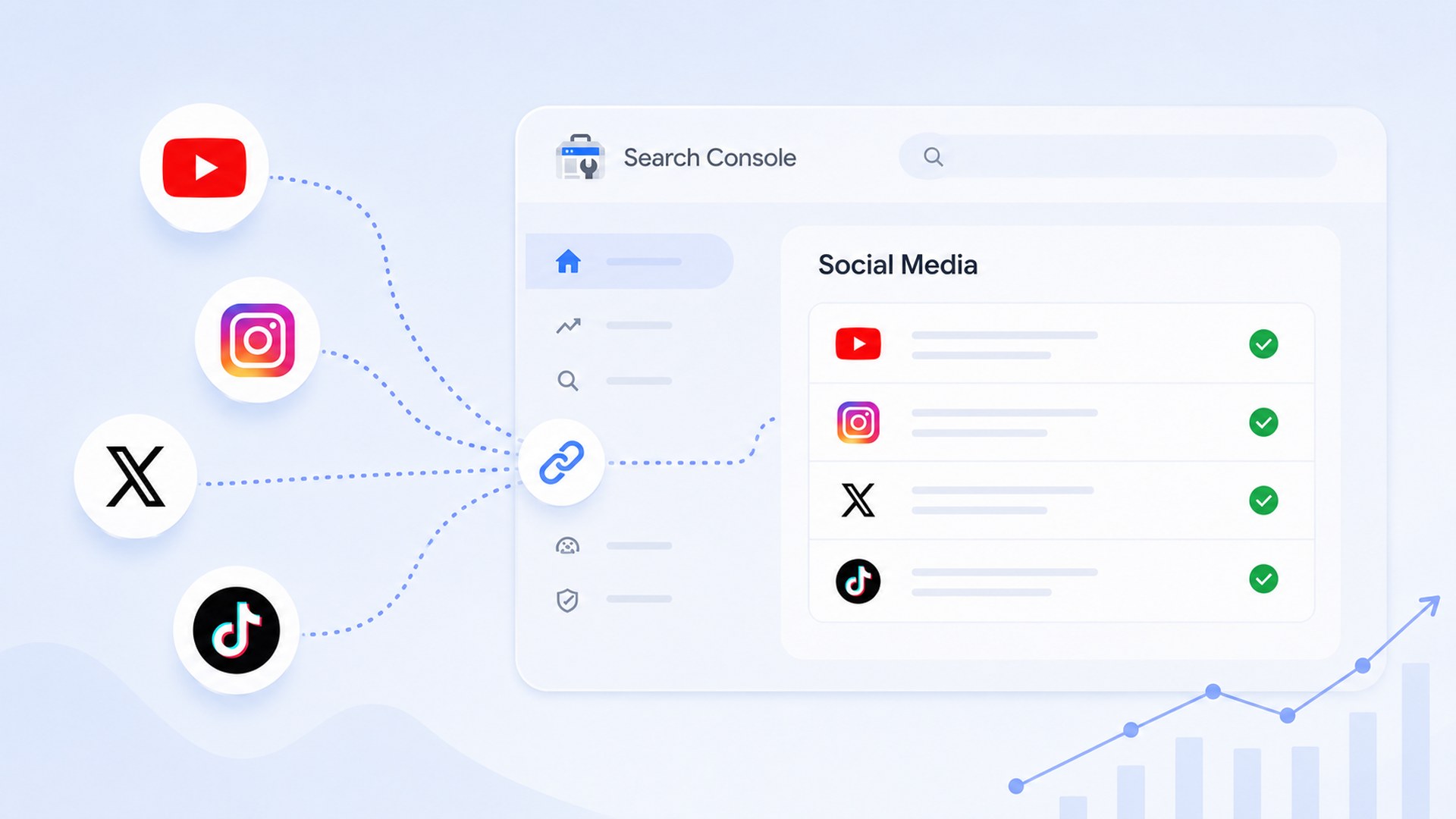


For years, Google Search Console ended at the border of your own website. Those who published on Instagram, TikTok, X, or YouTube could see the reach in the respective app, but never which Google search queries led people to these posts. Google is now closing exactly this gap. With the new platform properties, you can integrate social media accounts directly into Google Search Console, just as you could with websites before. Google announced the feature on July 7, 2026, and has been rolling it out worldwide for everyone since the end of July. Additionally, there is an official guide on how to meaningfully analyze the new data.
For companies and content teams, this is real progress: Your social posts and videos have long been part of Google Search and Google Discover. For the first time, it's possible to accurately measure how visible they really are there. We at projx will assess what the update can do, where its limits are, and how you can use it for your SEO and social strategy.
What are platform properties in Search Console?
A platform property is a new type of property in Google Search Console. Previously, you were familiar with two variants: the domain property and the URL prefix property. Both require that you own a website and can prove its ownership. The platform property works differently. You don't link a web project, but a social profile or a video channel.
At launch, Google supports four platforms:
Instagram: Profiles and their posts
TikTok: Channels and videos
X (formerly Twitter): Accounts and posts
YouTube: Channels and videos
Other networks like Facebook or LinkedIn are not yet supported. The key difference from a classic website property is that you don't need your own domain. This makes Search Console available for the first time to creators and brands whose main presence is a TikTok or Instagram profile, not a homepage.
How to connect your social media accounts to Google Search Console
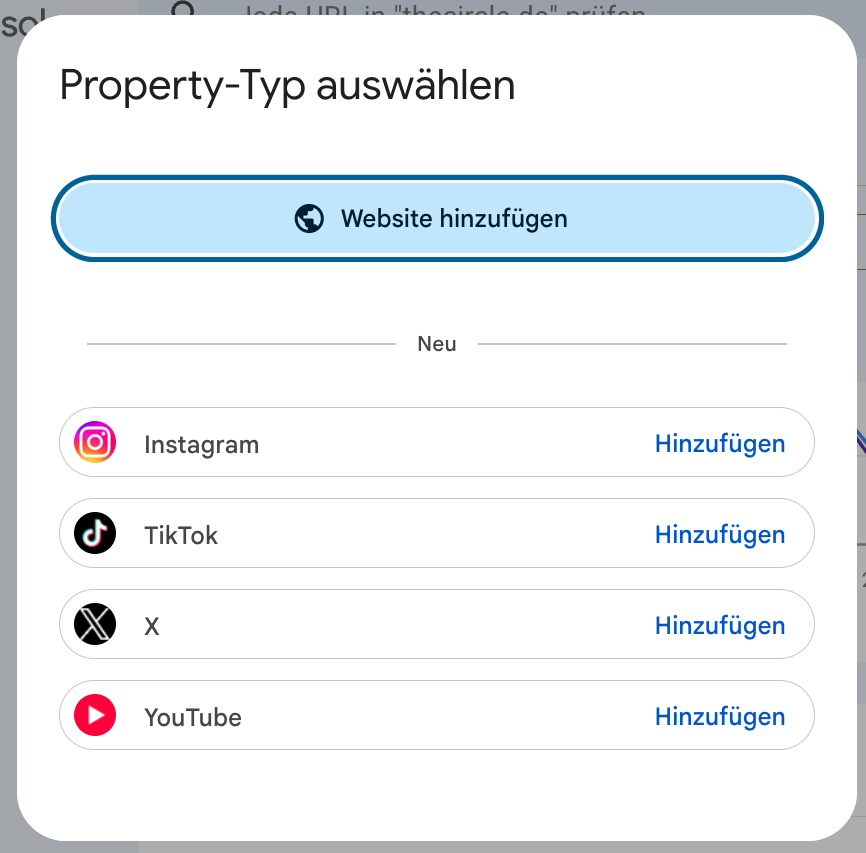
The setup takes only a few minutes and follows the familiar process for adding a property.
Choose property type: Open the property selector in Search Console. Next to the usual 'Add website' option, you will now find a 'New' section with the four platforms Instagram, TikTok, X, and YouTube.
Select platform: Click 'Add' for the desired platform.
Authorize account: The verification is not done via DNS or HTML verification, but via a secure login directly to the respective platform account. You authorize the connection, and you're done. If you operate multiple accounts on one platform, such as a company and a personal profile, you verify each one individually.
Wait for data: After adding, Search Console begins collecting performance data. It can take up to 48 hours for the first numbers to appear in the reports.
An important note on history: A platform property only collects data from the time of connection, just like a website property. There is no retroactive data. It is therefore worthwhile to connect your accounts early to build a reliable history as quickly as possible. If an account is already verified via a claimed Google Search Profile, Google will automatically add it to Search Console, according to their own information.
Why the update is important: Social posts have long been part of organic search
Search behavior has shifted. Short videos, social media posts, and profile cards now appear prominently in regular search results and the Discover feed. A TikTok video can rank for a product search without the creator ever knowing about it, because Google Search Console previously only measured websites.
Social platforms do provide their own statistics, but they only show how a post performs within their app. They don't reveal what someone searched for on Google before clicking on your post. Search Console now makes these search terms visible.
You see clicks, impressions, and the corresponding search queries for content that lies outside your own domain. This is the same treasure trove of data that previously only website owners had, now available for your social and video channels as well.
What data you can now see in GSC: Performance, Insights, and Achievements
For each linked platform property, Google provides three reports:
Performance: The classic metrics that SEOs have known for years, now for your social channels. You see clicks, impressions, click-through rate (CTR), and the average position in Google Search, Discover, and Google News.
Insights: A prepared overview of trends and your strongest posts, including query groups (more on that shortly).
Achievements: A report that highlights milestones and successes of your content.
Equally important is what these reports not show:
Only Google surfaces are recorded, i.e., Search, Discover, and News. The views, likes, or watch time that a post achieves within the platform itself are excluded. Search Console therefore measures the Google portion of your social reach, not the entire performance on TikTok or Instagram.
Six ways to use the new Google Search Console social data
In parallel with the worldwide rollout, Google has published a guide describing six concrete use cases. They serve as a good starting point for your analysis:
Analyze query groups: The Insights report bundles search terms into topic groups and shows which are currently trending up or down. This provides ideas for the next video, the next caption, or the right hashtag.
Use the 24-hour view: With the filter for the last 24 hours, you can detect sudden traffic spikes on new posts early enough to cross-promote them elsewhere.
Compare platforms: Export the data for each property and place YouTube, Instagram, X, and TikTok side by side in a table.
Find older successful content: Look for older videos that are regaining search traction. Such content is suitable for a sequel or a prominent spot in the feed.
Use annotations: Record when you have revised a YouTube title or a TikTok caption using annotations, and compare the performance before and after. This is a before-and-after note, not a controlled test.
Use comparison mode: Compare different data sets, for example, long YouTube videos against Shorts or Instagram posts against Reels.
And what does the update mean for your SEO and social strategy in concrete terms?
The update connects two worlds that are still thought of separately in many companies: classic organic search and social media marketing. Those who plan SEO and social together can now work with real Google data for the first time instead of estimates.
In practice, this means:
Content planning with search intent: The query groups show which search terms are used to find your social content. These signals belong in your editorial and topic planning.
Cross-channel reports: Search, social, and video data can be combined in a single report. This sharpens the focus on what share Google has of your total reach.
Realistic expectations: Because data is only generated from the time of connection and the approaches from the guide provide observations rather than controlled experiments, you should draw conclusions cautiously. The value increases with the data history.
A brief look back puts this all into perspective: As early as December 2025, Google had experimented with so-called social media channels in Search Console Insights. These were automatically detected based on your website and only displayed in the Insights section. The new platform properties go much further. You add the account yourself, they work without your own domain, and they feed three different reports.
Frequently Asked Questions about Platform Properties (FAQ)
We know that this topic can seem complex to some. Therefore, here are some questions answered briefly and clearly:
Do I need my own website to connect social accounts?
No. The platform property is the first property type you can verify without your own domain. You simply authorize the respective account.
Which platforms are supported?
At launch, Instagram, TikTok, X, and YouTube. Facebook and LinkedIn are not currently included.
Will I see my likes, views, and followers in Search Console?
No. Only Google surfaces are recorded, i.e., Search, Discover, and Google News, with clicks, impressions, CTR, and average position. Platform-internal metrics remain in the respective app.
Do I get retroactive data?
No. Data collection starts from the time of connection. After setup, it can take up to 48 hours for the first data to become visible.
Is the feature available to everyone yet?
Yes. Google made the announcement on July 7, 2026, and rolled out platform properties worldwide for everyone at the end of July.
Analyzing social visibility is becoming increasingly important!
With platform properties, Google Search Console is leaving the confines of one's own website for the first time. Instagram, TikTok, X, and YouTube can now be integrated as independent properties, entirely without a domain, and provide real Google data on clicks, impressions, and search queries in Search, Discover, and News. For teams that think about content, SEO, and social together, this creates a common data basis that did not exist before.
If you want to systematically measure your social visibility in Google Search and integrate it into your content strategy, we are happy to support you. In a non-binding initial consultation, we will look at your channels and show you how the new data can be used for measurable results.